
One Brand, Two Platforms: Formalising the merging of EWC Compute and Power Grid Edge Project Architectures
Engineering World Company · Company Architecture · April 2026. Author: Nuno Edgar Nunes Fernandes

A decision that was already true
There is a particular kind of business decision that consists entirely of making explicit what was already implicit.
When the first IoTEdgeSense firmware commit (first now outdated github pulll request) landed on the EWC Compute Platform GitHub organisation, the architecture of Engineering World Company was already decided in practice. The platform was using the same FastAPI/Pydantic backend conventions, the same Docker-first deployment philosophy, the same documentation discipline, and the same commitment to naming what does not yet exist rather than pretending it does. The code was separate. The thinking was not.
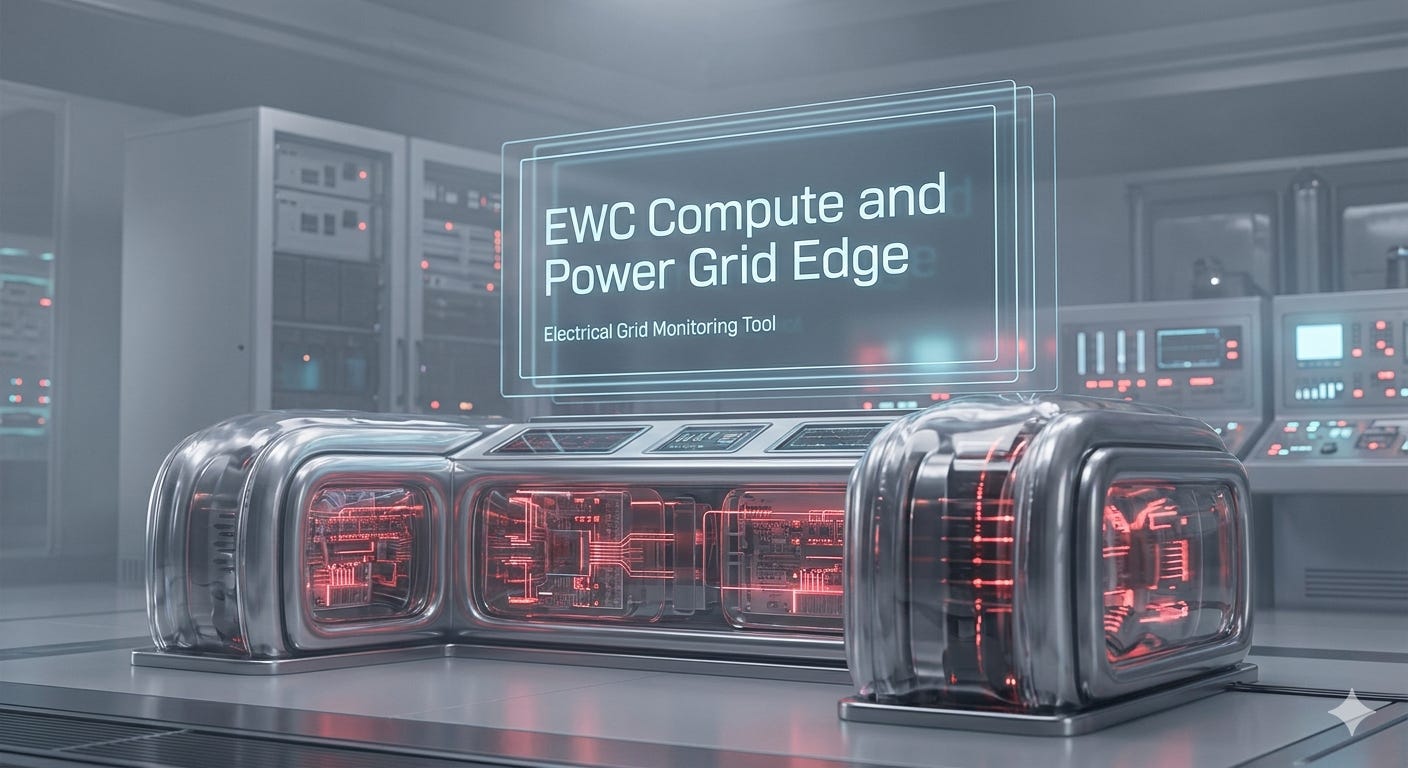
This post formalises what the code already said: IoTEdgeSense — the power grid monitoring technology solution developed under the Power Grid Edge Project — is now explicitly positioned under the Engineering World Company brand alongside EWC Compute. This is a business architecture decision. It is not a technical merge, not a repository consolidation, and not a versioning change. Both platforms maintain independent development trajectories, independent release cycles, and independent codebases. The reasoning for that separation is explained below, and it is technical, not political.
What changes is the frame. Engineering World Company is no longer two adjacent projects maintained by the same person. It is an industrial software company with two complementary platforms — one general-purpose, one domain-specific — and a product roadmap that extends further than either of them.
Why now — the industry context
The Microelectronics US 2026 conference (the link here already points to next year edition) ran last week in Austin, organised across three co-located tracks: Semiconductors US, Embedded Systems US, and Photonics US. The explicit co-location of those three tracks under a single event is itself a design statement. The engineering constraints being addressed across all three — performance per watt, thermal budget, safety certification, long-term reliability, security by construction — are not separable at the system level. A photonic chip that cannot be described by the same design toolchain that constrains its PCB carrier is a problem. An embedded processor whose firmware has no awareness of its thermal envelope is a problem. These are integration failures masquerading as component decisions.
The convergence being described at MicroelectronicsUS is the same convergence that motivates this architecture announcement. Industrial software that treats the software layer and the hardware layer as independent concerns will eventually hit the limits of that separation. The grid monitoring node running IoTEdgeSense firmware on an embedded Linux target has a thermal envelope, a power budget, a memory constraint, and a watchdog timer that are physically meaningful — not configuration parameters. EWC Compute’s Simulation Bridge adapter for electromagnetic domains exists precisely because the behaviour of a PCB trace at high switching frequencies is a physics problem before it is a software problem.
We are formalising the brand architecture now because the industry is arriving at the same set of conclusions we arrived at when building these platforms, and the conversation is happening in public at a scale — MicroelectronicsUS, embedded world, NVIDIA GTC’s OpenUSD commitments — that makes the positioning legible in a way it was not twelve months ago.
What the merge is
The merge is business architecture only. There is no technical change.
This matters enough to state precisely because "platform consolidation" is a phrase the software industry has used to justify a sequence of decisions that reliably destroy value: forcing unlike codebases into a monorepo because it looks cleaner, collapsing domain-specific schemas into generic ones because abstraction is mistaken for generality, and introducing shared dependencies between systems that have fundamentally different latency and reliability requirements.
IoTEdgeSense is C++17 firmware targeting embedded Linux. It runs on industrial edge hardware at substations, in weatherproof enclosures, on cellular and LoRaWAN links where bandwidth is constrained and reconnection after a power interruption is a meaningful engineering concern. Its real-time path — from sensor acquisition through Z-score anomaly detection to MQTT fault event publication over TLS — has hard latency requirements that are incompatible with interpreted language runtimes or remote database round-trips. The watchdog and power manager modules exist because the hardware environment is adversarial in ways that cloud-first software has the luxury of ignoring.
EWC Compute is a Python/FastAPI platform targeting engineers running design workflows from browser-based interfaces. Its compute-intensive operations are simulation solves dispatched to GPU infrastructure; its latency requirements are measured in seconds for solver dispatch and milliseconds for API responses, not in the microseconds that govern protection-class grid events.
These are different problems. Separate codebases are the correct answer. The shared architecture is in the decision-making patterns: Pydantic v2 for schema validation in Python, typed domain objects in C++; Docker-first deployment in both; explicit uncertainty quantification in the AI layers of both; human-in-the-loop confirmation before autonomous action in both. The shared artefact is the engineering discipline, not the dependency tree.
What the business architecture merge creates is:
A unified external identity. Engineering World Company is the name under which both platforms operate, both publications are written, and all customer and partner relationships are managed. IoTEdgeSense is “the EWC power grid vertical.” EWC Compute is “the EWC general engineering platform.” Prospects encountering either platform encounter the same company, the same values, and the same quality standard.
A structured cross-sell path. A utility company evaluating IoTEdgeSense for substation monitoring has, in many cases, mechanical and electrical engineers running design workflows on spreadsheets and disconnected simulation tools. The conversation from grid monitoring to digital twin capability is natural and technically coherent — both platforms speak the same language about software-defined workloads, physics-grounded AI, and reproducible engineering workflows. The business architecture makes that conversation straightforward rather than requiring an explanation of why two apparently separate products come from the same team.
A coherent product roadmap. The platforms share a trajectory. The next major capability area on that trajectory — microelectronics, EDA (Electronics Design Automation), PCB design and hardware-software co-design — is more naturally introduced as a third EWC vertical than as a standalone project with no visible relationship to what precedes it.
The shared DNA
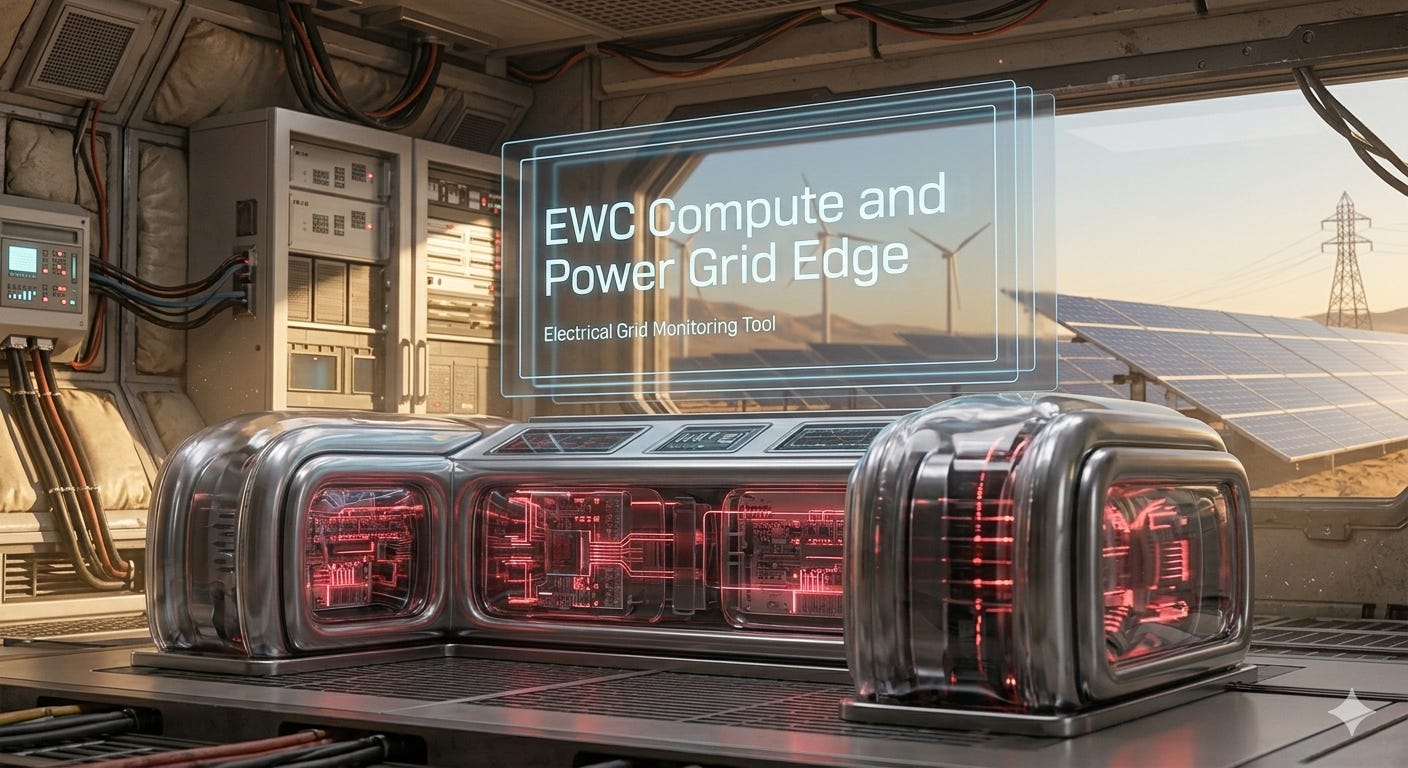
Both platforms are software-defined. Both are AI-native. Both treat the physics of the problem as a first-class constraint rather than a downstream validation step.
In IoTEdgeSense, “software-defined” means that the network topology, fault threshold matrix, sensor calibration parameters, and communication routing rules are expressed as software configuration — editable, versionable, deployable over-the-air — rather than hardwired into relay firmware and physical panel wiring. The PowerGridBridge translating sensor readings into typed GridFaultEvent objects, evaluated against IEC 60038 and EN 50160 thresholds at 20 fault categories, is software-defined grid intelligence. The substation knows its own state because software says so, not because a technician read a meter.
In EWC Compute, “software-defined” means the same thing at a different level of abstraction. Sim Templates are software-defined computational workflows — the solver type, mesh strategy, boundary conditions, convergence criteria, and output targets are expressed as a Pydantic v2 schema that validates before execution and produces reproducible results. The ai_mode field — generative, surrogate, principled_solve — is a software-defined statement about how physics should be engaged, made explicit rather than hidden in a configuration file someone last edited in 2019.
“AI-native” is a specific technical claim in this context, not a marketing adjective. In IoTEdgeSense, it means the Z-score anomaly detection and fault classification run on-node, in the edge processing pipeline, before data is transmitted. The intelligence is at the measurement point. In EWC Compute, it means the Physical AI Assistant’s DSR-CRAG retrieval pipeline enforces physics consistency on retrieved responses before they reach the engineer — the AI is not an external tool consulted after the fact, it is part of the workflow architecture. In both cases, the AI capability is a structural property of the platform, not a feature added after the core was built.
Both platforms treat hardware constraints as real. The IoTEdgeSense firmware power manager — managing six power modes with automatic transitions based on battery level — exists because edge hardware runs on batteries and a firmware that drains them in twelve hours is useless regardless of its other capabilities. EWC Compute’s roadmap to CUDA-X acceleration through cuDSS and AmgX exists because the solver runtimes without GPU acceleration are measured in hours for the problem sizes our users actually have. In both cases, the hardware is not an implementation detail — it is a design constraint that the software must account for explicitly.
The engineering vertical that comes next
The natural extension of this architecture is hardware-software co-design. Not as a vision statement — as a concrete engineering capability with a defined technical scope.
IoTEdgeSense runs on embedded Linux targets ranging from Raspberry Pi to purpose-built industrial gateways. The firmware stack it runs — C++17, CMake, Paho MQTT, hardware bus drivers — is the same stack that runs on microcontrollers and SoCs designed for specific industrial applications. A custom ASIC for grid edge monitoring — with hardware accelerators for the Z-score anomaly detection and IEEE C37.118 PMU processing that currently run in software — is not a speculative future product. It is a natural engineering optimisation of the current firmware architecture, once the software behaviour is validated and stable.
EWC Compute’s Simulation Bridge already defines interface slots for EDA and collision dynamics solvers (Phase 3 integrations). The EDA slot exists because electromagnetic simulation — signal integrity, power delivery network analysis, EMI compliance checking — is a simulation domain, not a separate category of tool. The boundary between “simulation platform” and “chip design platform” is an organisational convention inherited from the history of EDA vendors, not a physical law.
The microelectronics vertical we are planning under Engineering World Company is not a diversification. It is a vertical integration of capabilities that are already implied by the existing platforms. IoTEdgeSense needs custom silicon eventually. EWC Compute needs EDA simulation backends. Both need PCB design tooling that understands the physical constraints of the boards those chips sit on — thermal, signal integrity, power distribution.
When that vertical launches — and a separate project thread for EDA, electronics, and semiconductor design is already being scoped — it will arrive under the Engineering World Company name, with the same discipline and the same commitment to making the engineering reasoning visible rather than hiding it behind marketing claims.
This is also the convergence that MicroelectronicsUS 2026 was structured around: Semiconductors, Embedded Systems, and Photonics as three stages under one roof, addressing the same performance-power-thermal-reliability constraints from three different entry points. The industry is converging on hardware-software co-design as the default engineering mode. Engineering World Company’s architecture is already structured for it.
What this means for the Substack
Both publication streams continue on their current cadence and technical depth. The IoTEdgeSense series will cover the remaining firmware modules (power manager, CoAP client, unit test suite, CI pipeline), the SDN platform integration, and the path to IEC 61850 compliance. The EWC Compute series continues through the Digital Twin Engine (OpenUSD, physics parameterisation), Sim Templates (the three AI modes in detail), and the Physical AI Assistant (DSR-CRAG in practice).
What changes is that both streams now explicitly reference each other where the connection is real, not forced. The discussion of edge thermal constraints in an IoTEdgeSense post will reference EWC Compute’s thermal simulation backend when that backend exists. The discussion of EDA simulation in an EWC Compute post will reference the IoTEdgeSense use case for custom silicon when that conversation is ready to be had publicly.
The Engineering World Company Substack is the reasoning record for both platforms. The discipline of explaining an architecture clearly enough that an engineer who has never seen the codebase can evaluate its decisions is the same discipline required to make the right decisions in the first place. The writing and the building are not separate activities.
Closing
The electrical grid is critical infrastructure. The simulation tools that engineers use to design the hardware sitting inside it are critical tools. The firmware running in the edge nodes monitoring that grid is critical software. None of these are separable from each other in the ways that software industry category conventions suggest.
Engineering World Company is building the platform that treats them as the integrated system they actually are — starting with the software-defined layers that are accessible now, with full intention of extending to the hardware layers that will matter next.
One brand. Two platforms. One engineering discipline. A clear view of what comes after.
Power Grid Edge Project (IoTEdgeSense): github.com/EWC-Compute-Platform/Power-Grid-Edge-Project EWC Compute Platform: github.com/EWC-Compute-Platform Engineering World Company · engineeringworldcompany.substack.com
Engineering World Company covers the methods, tools, and decisions behind modern computational and industrial engineering — and builds the platforms to make them accessible.