
After Ingenuity: NVIDIA Declares Space Computing's Frontier, Europe Puts 13 Satellites in One Morning, and JPL Breaks the Sound Barrier on Mars
Co-written by Nuno Edgar Nunes Fernandes, 12th May 2026

Three stories that belong together: a 1-minute NASA video of a rotor blade spinning past Mach 1 inside a low-density chamber in Pasadena; Jensen Huang on a GTC stage declaring that intelligence must live wherever data is generated; and a Sunday morning rideshare putting thirteen European satellites into orbit before most of the continent was awake. Engineering does not announce itself. It accumulates.
Editor’s Note
What Progress Actually Looks Like
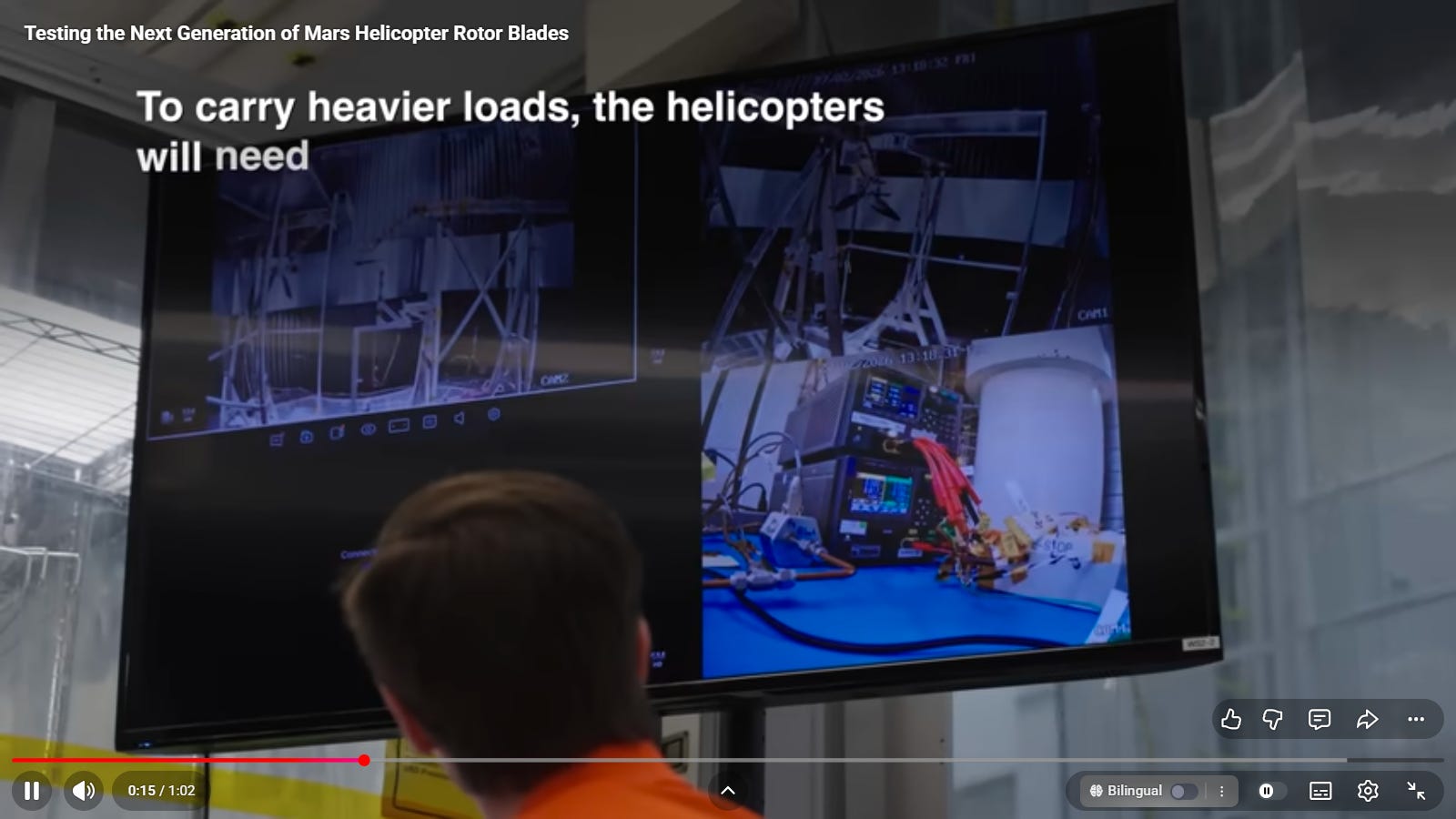
There is a particular quality to engineering progress that does not translate well into press cycles. It does not happen in announcements. It happens in test runs — 137 of them, in this week’s most important story — each one adding a data point to a distribution, each distribution narrowing the uncertainty envelope around a design that must work on another planet. NASA JPL (Jet Propulsion Laboratory) published the results of those 137 runs on May 7, two years after Ingenuity’s final flight and four years after its first, and the headline is both precise and extraordinary: the rotor blade tips of the next-generation Mars helicopter, a programme now named SkyFall, have exceeded the speed of sound without structural failure. That is the sentence that matters.
NVIDIA’s Space-1 Vera Rubin Module announcement from GTC in March has not appeared in these pages until now, and the delay has been useful: we can read it in the light of the thesis refinement we made last week, separating space-native orbital compute from the terrestrial-competing data centre vision. The Vera Rubin Module is unambiguously a space-native compute story — smaller, lighter, more power-efficient than anything that came before it, built for the orbital environment rather than adapted from it. Jensen Huang’s GTC framing — “intelligence must live wherever data is generated” — is the clearest public articulation of the space-native thesis this industry has produced.
And Europe, quietly, put thirteen satellites into orbit on a single Falcon 9 rideshare on the morning of May 3. Seven for Italy’s IRIDE constellation. Four for Greece’s national wildfire surveillance system — a world first. Two CubeSats testing optical data transmission in space, directly relevant to the photonics thesis that now anchors this publication. None of this required a press conference. It just happened, as accumulation does.
Section 01 · Human Spaceflight
SkyFall, Starship, and the Dragon at the Door
Ingenuity made its 72nd and final flight on January 18, 2024, having survived 1,000 Martian days in an environment it was never designed to endure. It carried no science instruments. Its entire purpose was to prove that powered, controlled flight on another world was physically possible. It did that, and it did it so thoroughly — so far beyond its planned five flights — that the question of what comes next shifted from “can it fly?” to “what can it carry?” The answer to that question is what JPL has been building toward in the low-density chamber at Pasadena, and what the May 7 results represent: a design capable of carrying instruments.
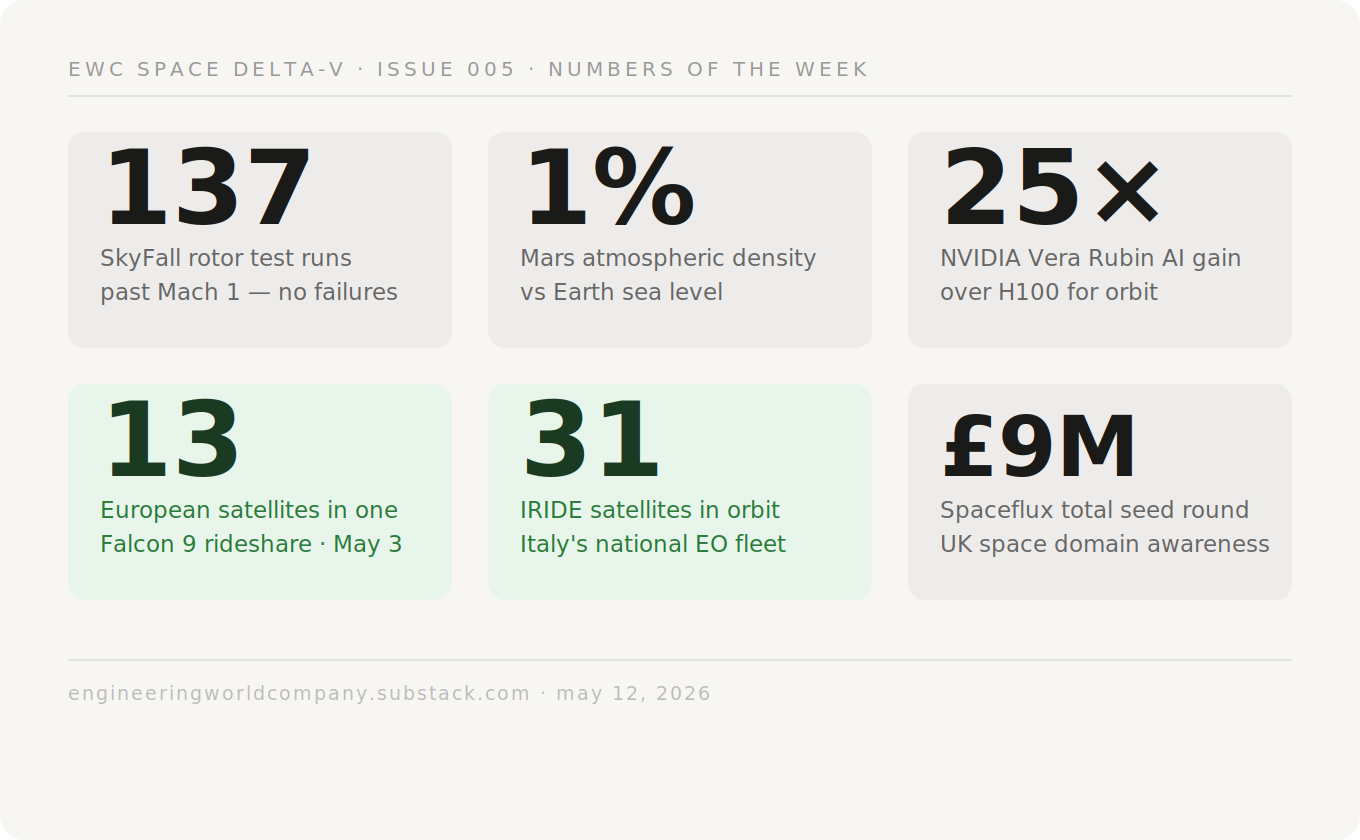
The programme now carrying that answer has a name: SkyFall. The rotor blades that will power it were developed and manufactured by AeroVironment in Simi Valley — the same company that built Ingenuity’s rotor system — and tested across 137 documented runs in a chamber that replicates the Martian atmosphere’s density of approximately 1% of Earth’s sea-level value. The blade tips were accelerated past Mach 1. They did not fail. The test results clear one of the most significant aerodynamic hurdles in the SkyFall development programme, and the engineering physics of exactly why this is hard is examined in this week’s Technical Deep-Dive in Section 07.
The explicit mission framing from JPL's video description is worth stating directly: SkyFall-class helicopters are designed to "carry small payloads — like instruments and sensors — to collect data in support of future human and robotic missions." This is the transition from technology demonstration to operational science platform. Ingenuity scouted terrain for Perseverance. SkyFall scouts terrain, takes measurements, deploys sensors, and returns data that mission planners cannot obtain from orbit or from a rover constrained to the surface. The scientific utility multiplier is substantial.
Elsewhere in this week’s section 01 edition: SpaceX CRS-34 launches today — the day this issue publishes — delivering over 6,400 pounds of science experiments and crew supplies to ISS on a Dragon spacecraft flying its sixth mission. Starship Flight 12 is imminent from Starbase, Texas: Ship 39 and Booster 19, the first version-3 integrated Starship system, targeting liftoff within this week’s window. Flight 12 is the first Starship to incorporate structural and propulsion changes from the lessons of Flights 7 through 11 — it is as much a new vehicle as a continuation of the test programme. And from China: the first uncrewed orbital flight of the Mengzhou spacecraft on the Long March 10A rocket remains on the 2026 schedule, carrying China’s crewed lunar programme a step closer to its first hardware-in-orbit validation.
Section 02 · Market Structure
Neutron Slips, and an Unexpected Industrial Grouping Emerges
Rocket Lab’s Neutron rocket — the medium-lift vehicle that represented the most credible commercial challenger to SpaceX’s Falcon 9 in its payload class — has slipped its debut to no earlier than the fourth quarter of 2026, following a first stage tank test failure earlier this year. The first Neutron flight will not be reusable; booster recovery is targeted for the second flight. This is a meaningful setback for a programme that had been tracking toward a mid-2026 inaugural. The tank test failure is not a catastrophic engineering problem — it is exactly the kind of anomaly that full-scale ground testing exists to find — but the schedule impact compounds Rocket Lab’s competitive position at a moment when Blue Origin’s New Glenn is itself grounded pending the NG-3 upper stage investigation. The medium-lift market between Falcon 9 and Falcon Heavy currently has no operational competitor. That gap persists for at least another two quarters.
Lockheed Martin announced this week that it is joining a collaboration with Firefly Aerospace and Seagate for offshore launch operations, building on Firefly’s Alpha rocket programme and Seagate’s data storage infrastructure interests. The grouping is unusual — a prime defence contractor, a commercial small launch provider, and a data storage company — and its strategic logic is not immediately obvious from the announcement. Offshore launch from maritime platforms removes regulatory constraints on launch azimuth, potentially enabling orbital inclinations not achievable from fixed land sites. Whether this is a genuine programme or an early-stage industrial exploration will become clearer when a launch site and customer manifest are named. Worth watching.
Section 03 · European Sovereign Space
Thirteen Satellites, One Morning, Three Countries
On the morning of Sunday May 3, a SpaceX Falcon 9 lifted off from Vandenberg carrying thirteen European satellites — seven for Italy, four for Greece, two for Greece again — and delivered all of them to orbit before most of Europe had finished breakfast. The compression of significance into a single rideshare launch is worth unpacking deliberately, because each of these three programmes represents something distinct about where European sovereign space capability is heading.
The seven IRIDE satellites are the latest addition to Italy’s national Earth observation constellation, now totalling 31 spacecraft on orbit. IRIDE is funded through Italy’s National Recovery and Resilience Plan — NextGenerationEU capital deployed into national space infrastructure — and coordinated by ESA with support from ASI. The HEO satellites carry multispectral high-resolution optical instruments for coastal monitoring, land use analysis, and emergency management. Italy has quietly built one of the most capable national EO constellations in Europe, and the May 3 launch advances it further.
The four Hellenic Fire System satellites are the more remarkable story in engineering terms. Greece has become the first country in the world to deploy a national satellite constellation specifically designed for wildfire detection and tracking. The Aegean and Mediterranean basin’s wildfire risk profile — exacerbated by every consecutive drought year — has driven a genuine national security imperative: detect ignitions from orbit before they become uncontrollable ground events. The four satellites provide near-continuous coverage of Greek territory at sufficient temporal resolution to serve as an early warning system rather than a post-event documentation tool. This is photonic and optical engineering applied to a climate adaptation problem, at national scale, funded by the same EU recovery mechanism that funded Neuraspace in Portugal. The policy architecture is beginning to produce operational space infrastructure.
The two Hellenic Space Dawn CubeSats are the most technically relevant to this publication’s thesis. They are testing satellite communication links and optical data transmission in orbit — laser and optical comms demonstrations on a Greek national programme, launched alongside the fire system satellites. ESA’s Laurent Jaffart, Director of Resilience, Navigation and Connectivity, noted explicitly that the mission “showcases innovative optical communications” as part of building Europe’s next-generation connectivity architecture. A national government deploying optical comms testbeds on CubeSats as part of a multi-satellite rideshare is no longer an experimental edge case. It is the emerging standard for how European space programmes are built.
Two other European developments this week deserve mention. ESA’s SMILE mission — the Solar wind Magnetosphere Ionosphere Link Explorer, a joint programme with the Chinese Academy of Sciences — is on the launch manifest schedule (May18/19) for a Vega-C from Kourou imminently, representing ESA’s most significant active collaboration with the Chinese space programme and a heliophysics mission that will study the dynamic interaction between solar wind and Earth’s magnetosphere in real time. And ESA launched a dedicated Extended Reality Competence Centre this week, releasing an XR Plugin built on Unreal Engine and OpenXR for space training and simulation applications — a development directly relevant to EWC Compute’s digital twins and simulation platform work.
Section 04 · Photonics for Space — Our Core Thesis
NVIDIA Declares the Frontier: The Space-1 Vera Rubin Module and What It Actually Means
This is where this publication dwells most deeply each week — the photonic and optical layer of space infrastructure, examined from inside the engineering domain. Everything else is context. This is the signal. And this week the signal comes from a GTC stage in March, covered here for the first time because it deserves more than a headline.
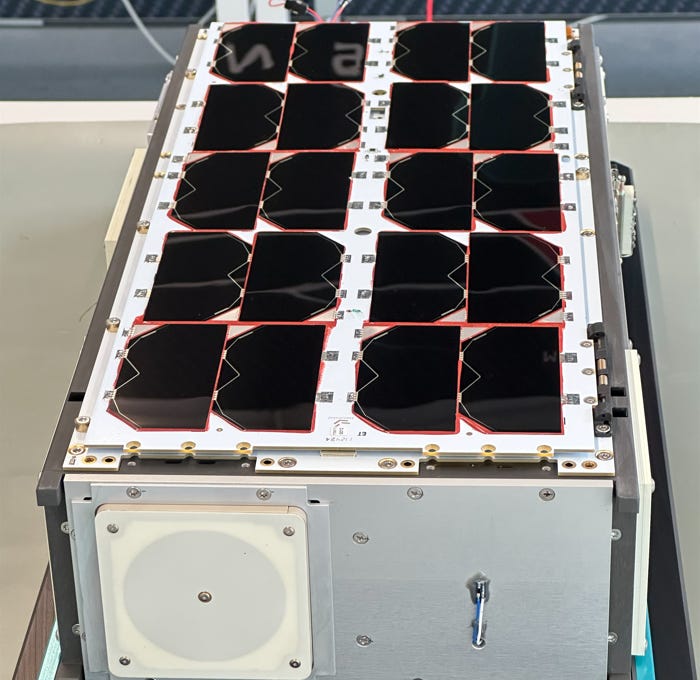
On March 16, Jensen Huang stood at the NVIDIA GTC conference and announced the Space-1 Vera Rubin Module — a space-qualified compute platform delivering up to 25 times the AI inferencing performance of the H100 GPU, engineered specifically for the size, weight, and power (SWaP) constraints of orbital platforms. The announcement named six partner companies already using NVIDIA accelerated computing for space missions: Aetherflux, Axiom Space, Kepler Communications, Planet Labs, Sophia Space, and Starcloud. Every one of those companies has appeared in this publication’s Section 04 analysis over the past four issues. That is not a coincidence. It is a map of the orbital compute ecosystem as it currently exists, centred on a single silicon supplier.
Huang’s framing is worth quoting precisely because it states the space-native compute thesis more clearly than anything previously published by a major technology company: “Space computing, the final frontier, has arrived. As we deploy satellite constellations and explore deeper into space, intelligence must live wherever data is generated. AI processing across space and ground systems enables real-time sensing, decision-making and autonomy, transforming orbital data centers into instruments of discovery and spacecraft into self-navigating systems.” The phrase “instruments of discovery” is not marketing language. It is the correct engineering description of what an inference-capable constellation does: it does not transmit raw data to be analysed on the ground. It generates knowledge at the point of observation.
The SWaP framing of the Vera Rubin Module is where the photonics dimension enters directly. Size, weight, and power constraints in orbital hardware are not independently optimisable — they are coupled through thermal management. A more powerful compute chip generates more heat. More heat requires more radiator area. More radiator area adds mass. More mass requires more launch Δv. The only architectural path that breaks this coupling is to reduce the heat generated per unit of compute — which means either more efficient silicon, or photonic interconnects that move data between chips at the speed of light with near-zero resistive heating. The Vera Rubin Module addresses the silicon efficiency dimension. The photonic interconnect generation is what follows it. This is the transition point that Precision with Light’s optical simulation capability is positioned to support: the design and validation of photonic chip interconnects for the thermal-budget-constrained orbital compute environment.
The partner ecosystem statements from the GTC announcement are worth reading as a sector map. Aetherflux CEO Baiju Bhatt: “NVIDIA Space-1 Vera Rubin Module delivers high-performance, energy-efficient AI at the edge in orbit, powered by solar energy — enabling autonomous operations and mission-critical services.” Kepler CEO Mina Mitry: “NVIDIA Jetson Orin brings advanced AI directly to our satellites, allowing us to intelligently manage and route data across our constellation.” Planet CEO Will Marshall: “By integrating NVIDIA’s accelerated platform from space to ground, we are supercharging our ability to index the physical world.” Three different companies, three different use cases — power beaming infrastructure, inter-satellite networking, Earth observation — all converging on the same silicon platform. The orbital compute ecosystem is forming around NVIDIA the same way the terrestrial AI infrastructure ecosystem did after the transformer architecture went mainstream. The platform lock-in dynamics are already visible.
One structural observation for this publication’s running thesis: the Vera Rubin Module announcement does not change the conclusion we reached last week about the SpaceX S-1 disclosure. The distinction between space-native orbital compute — serving the satellite’s own operations, the constellation’s own intelligence, the mission’s own needs — and terrestrial-competing orbital compute — selling processed outputs to Earth-based customers in competition with AWS — remains the correct analytical frame. Every partner in NVIDIA’s space ecosystem announcement is building the former. None of them is building a data centre that competes with Azure on price per FLOP. The thesis is intact and the Vera Rubin Module is its most significant hardware validation to date.
EWC intersections this week are the most direct of any issue to date. The Vera Rubin Module’s SWaP constraints and the photonic interconnect transition map directly onto the Precision with Light platform’s simulation domain. The Hellenic Space Dawn optical comms CubeSats are a European national programme demonstrating free-space optical transmission in orbit — the same class of link that the Cailabs MPLC ground station (Issue 004 Technical Deep-Dive) terminates on the ground side. The SkyFall rotor blade aerodynamics (Section 07) uses carbon fibre composite materials whose optical characterisation and structural monitoring is increasingly handled by photonic sensing — Brillouin scattering fibre sensors, fibre Bragg gratings — embedded in the blade structure. The photonics thread runs through every section of this issue.
Section 05 · One to Watch
Spaceflux: The Other Side of the Space Traffic Problem
EUROPE Active Signal
Last week we introduced Neuraspace — the Coimbra-based company using ML-driven fusion of optical and radar tracking data to predict conjunction events and recommend avoidance manoeuvres. This week, a complementary signal from the same sector: Spaceflux, a UK-based space domain awareness startup, extended its seed round with an additional £3.5 million, bringing total funding to £9 million. The company tracks objects in orbit using a combination of ground-based optical sensors and data analytics, focused on the real-time tracking layer that feeds into conjunction assessment systems like Neuraspace’s.
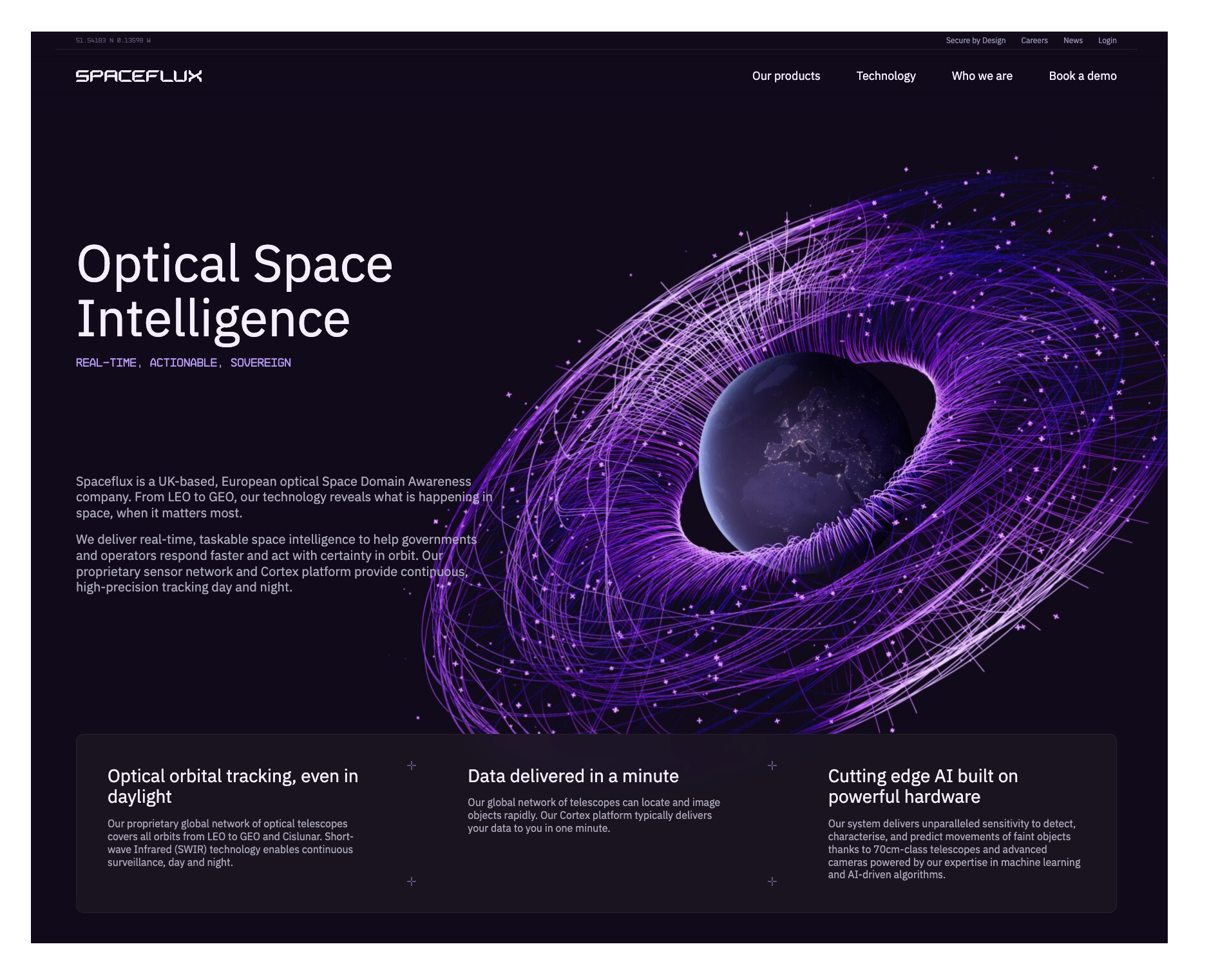
The distinction between Spaceflux and Neuraspace is architectural rather than competitive. Neuraspace’s strength is in the ML prediction and manoeuvre recommendation layer — what happens after tracking data is collected. Spaceflux’s strength is in the sensor network and data quality layer — the observational infrastructure that tracking data is collected from. Both are necessary components of a functioning space traffic management system, and the European sector is building them in parallel, from different countries, with different funding sources. The convergence of these capabilities into interoperable infrastructure is the outcome the sector needs; the current landscape of independent national programmes and startup-level sensor networks is the reality it is working from. £9 million is early-stage funding for a serious infrastructure problem. The number to watch is when Spaceflux’s sensor network reaches the coverage density that makes its data commercially differentiated from what the US Space Surveillance Network already provides for free.
Section 06 · Numbers of the Week
Section 07 · Technical Deep-Dive — Issue 005
Why SkyFall Must Break the Sound Barrier: The Aerodynamics of Flying on Mars
Aerospace engineering · Rarefied aerodynamics · Rotorcraft design
Ingenuity’s 72 flights on Mars established that powered flight in a 1% density atmosphere is possible. What they also established, precisely through the data they generated, is the envelope within which it is possible — and the hard physical boundary that any heavier aircraft must push against. SkyFall must carry science instruments. Science instruments have mass. Mass requires more lift. More lift in a near-vacuum atmosphere requires faster blade tips. Faster blade tips eventually reach the speed of sound. What happens at and beyond that boundary — and how AeroVironment’s new rotor design survives it — is the engineering story of this week’s test results.
The Lift Equation in a Near-Vacuum
Lift generated by a rotor blade is proportional to the density of the fluid it moves through, the square of the relative velocity between blade and air, the blade’s planform area, and its lift coefficient. On Earth, atmospheric density at sea level is approximately 1.225 kg/m³. On the Martian surface, the CO₂-dominated atmosphere has a density of approximately 0.015 to 0.020 kg/m³ — roughly 1.2 to 1.6% of Earth’s sea level value. Mars gravity is 3.72 m/s², approximately 38% of Earth’s, which reduces the weight of the vehicle that must be lifted. These two effects partially offset each other, but the density deficit dominates: a Mars helicopter must generate lift in a fluid approximately 60 to 80 times less dense than the one that terrestrial rotorcraft operate in.
The engineering response to low density is to increase velocity — specifically blade tip velocity, which is the dominant term in the relative velocity experienced by the outer section of the rotor blade where most lift is generated. Ingenuity’s coaxial counter-rotating blades spun at approximately 2,400 rpm, producing blade tip speeds of roughly 200 m/s — about 65% of the speed of sound in the Martian atmosphere. For the 1.8-kilogram Ingenuity, this was sufficient. For SkyFall’s heavier payload requirement, it is not. The blade tips must spin faster. And faster means approaching, then crossing, Mach 1.
The speed of sound in the Martian atmosphere is approximately 240 m/s at surface temperatures, compared to 343 m/s at standard Earth sea level conditions. The lower value reflects both the cold surface temperatures (averaging around -60°C) and the higher molecular weight of CO₂ relative to Earth’s nitrogen-oxygen mixture. A blade tip operating at Mach 0.9 on Mars is moving at roughly 216 m/s — already within the transonic regime where compressibility effects become significant. The JPL tests pushed tips beyond Mach 1, into the supersonic regime, where shock waves form on the blade surface and drag increases dramatically. Surviving this regime structurally and aerodynamically across 137 test cycles is what the AeroVironment blade design has now demonstrated.
The Transonic Problem: Compressibility, Shockwaves, and Mach Tuck
In incompressible aerodynamics — the regime where Ingenuity’s blade tips operated for most of its mission — air behaves as a fluid that simply accelerates around the blade profile. As blade tip speed approaches the speed of sound, this assumption breaks down. The airflow over the upper surface of the blade accelerates locally beyond the free-stream velocity; at certain blade geometries and angles of attack, the local flow on the suction surface can go supersonic even when the free-stream tip speed is still subsonic. This produces a normal shock wave on the upper blade surface — a discontinuity in pressure and density that generates a sudden drag increase, strong enough to be felt as a torque spike by the drive system.
Above the critical Mach number, the shock wave moves progressively toward the trailing edge as tip speed increases. The pressure distribution over the blade surface shifts rearward, moving the centre of pressure toward the trailing edge and creating a nose-down pitching moment — the phenomenon known as Mach tuck in fixed-wing aviation, and its rotary equivalent in rotor blade dynamics. For a rotor blade cycling through varying angles of attack on every revolution, this pitching moment introduces torsional oscillation that must be absorbed by the blade’s structural stiffness and damping. The AeroVironment three-blade design — visible in the test facility images with its characteristic swept tip geometry — incorporates the blade planform shape and composite layup required to manage these torsional loads at supersonic tip speeds, across the thermal cycling of a Martian day, across 137 test runs without structural failure.
Material Science: Carbon Fibre at Supersonic Tip Speeds
The rotor blades are carbon fibre composite structures — unidirectional and woven carbon fibre plies in an epoxy matrix, layered and oriented to provide the specific combination of bending stiffness, torsional stiffness, and aeroelastic tailoring that the design requires. At supersonic tip speeds the structural demands are severe. The centrifugal load at the blade root — proportional to the square of rotational speed — increases substantially as rpm rises toward and beyond the Mach 1 threshold. The aerodynamic loads become highly non-linear in the transonic and supersonic regime. And the Martian thermal environment adds a further constraint: surface temperatures cycle between approximately -73°C at night and -13°C in midday sun, and the composite material properties — stiffness, strength, thermal expansion — vary across this range in ways that must be accounted for in the structural design.
The 137-run test dataset is significant precisely because it addresses the statistical question that a single successful run cannot. A single pass through Mach 1 without failure is a data point. One hundred and thirty-seven passes without failure is a Weibull distribution — an empirical reliability argument that tells JPL something meaningful about the blade’s survival probability across a mission profile involving many flights. The test methodology is designed to bracket the uncertainty that the Mars environment introduces: unknown particle contamination, thermal shock on the first morning spin-up, dust accumulation on blade surfaces over an extended mission. Demonstrating structural integrity across 137 runs under controlled conditions narrows the uncertainty envelope for the operational mission without eliminating it. This is how engineering decisions about planetary hardware are actually made: not by achieving perfection, but by characterising the failure modes well enough to design around them.
Ingenuity to SkyFall: The Architecture Shift
Ingenuity used a coaxial counter-rotating two-blade rotor configuration: two sets of two blades, spinning in opposite directions on the same shaft, cancelling rotor torque without requiring a tail rotor. The design is elegant for a technology demonstrator because it minimises complexity and maximises the blade area that can be packed into a given rotor diameter. SkyFall’s design — visible in the test images as a three-blade horizontal rotor alongside a two-blade vertical test configuration — indicates a different architectural approach for the science-capable successor. The addition of a third blade to one rotor increases blade area without increasing rotor diameter, which keeps the blade tip speed achievable at a given target lift. The swept tip geometry visible on the test blades is the standard approach to managing the transonic drag rise: sweeping the tip rearward increases the effective chord-wise Mach number at which the tip operates, delaying the onset of the shock wave and managing its location on the blade surface at higher tip speeds.
AeroVironment — the manufacturer — is not a name that surfaces often in space technology coverage, but it is the precise engineering partner this programme requires. The company’s background in small autonomous aircraft, high-altitude long-endurance vehicles, and unmanned aerial systems gives it the composite rotor blade manufacturing expertise and aerodynamic analysis capability that a Mars rotorcraft development demands. The continuity from Ingenuity to SkyFall within the same industrial relationship is an underappreciated advantage: the institutional knowledge of what works in that specific low-density test chamber, at those specific rpm ranges, does not need to be rebuilt from scratch.
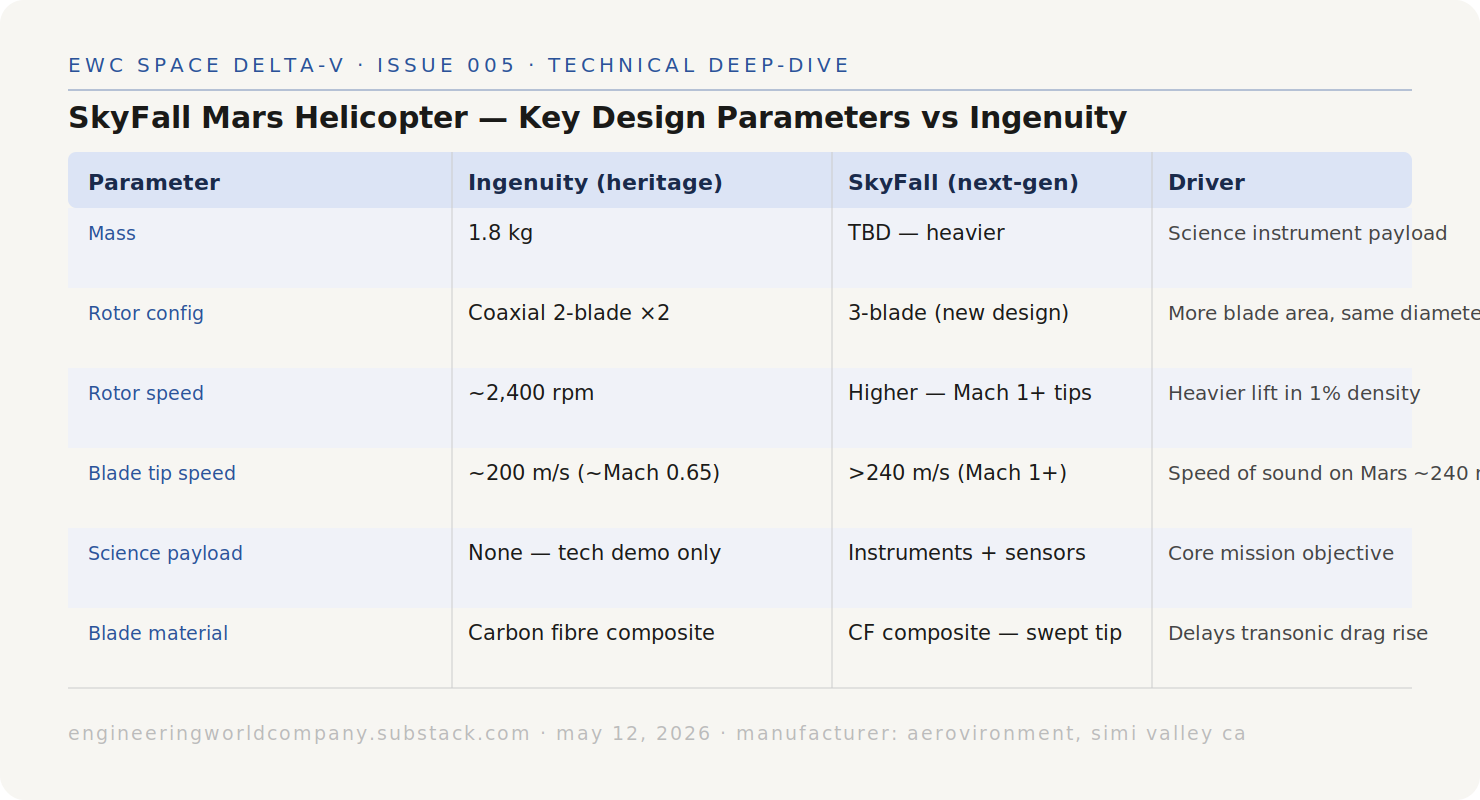
SkyFall does not yet have a confirmed launch date. It is a technology development programme currently in the rotor blade qualification phase. What the May 7 test results confirm is that the most physically demanding constraint — aerodynamic survival at supersonic tip speeds — has been addressed in hardware, across a statistically meaningful test campaign. The next constraints are mass, power, avionics, and landing gear for terrain that Ingenuity’s scouts photographed but never touched. Each of those is also a solvable engineering problem. The sound barrier was the hardest one, and JPL’s team broke it 137 times in a row.
References & Sources
Issue 005 — Primary References
Section 01 — Human Spaceflight / SkyFall
NASA pushes next-gen Mars helicopter rotor blades past Mach 1 — NASA JPL, May 7 2026
Testing the Next Generation of Mars Helicopter Rotor Blades — NASA JPL YouTube, May 7 2026
Section 02 — Market Structure
Section 03 — European Sovereign Space
Launch boosts European Earth monitoring and connectivity — ESA, May 4 2026
Extended Reality at ESA opens new pathways — ESA / Copernical, May 7 2026
Section 04 — Photonics for Space / NVIDIA Vera Rubin
Section 05 — One to Watch / Spaceflux
Section 07 — Technical Deep-Dive: SkyFall Rotor Aerodynamics
EWC Space Delta-V is a weekly technology intelligence publication by Engineering World Company, published every Tuesday. It covers the photonic and optical layer of space infrastructure, and the engineering physics that governs it. Nuno Edgar NunesFernandes is a physics engineer with a background in optoelectronics and photonics, building AI-assisted engineering platforms across photonics, quantum computing, and industrial simulation.